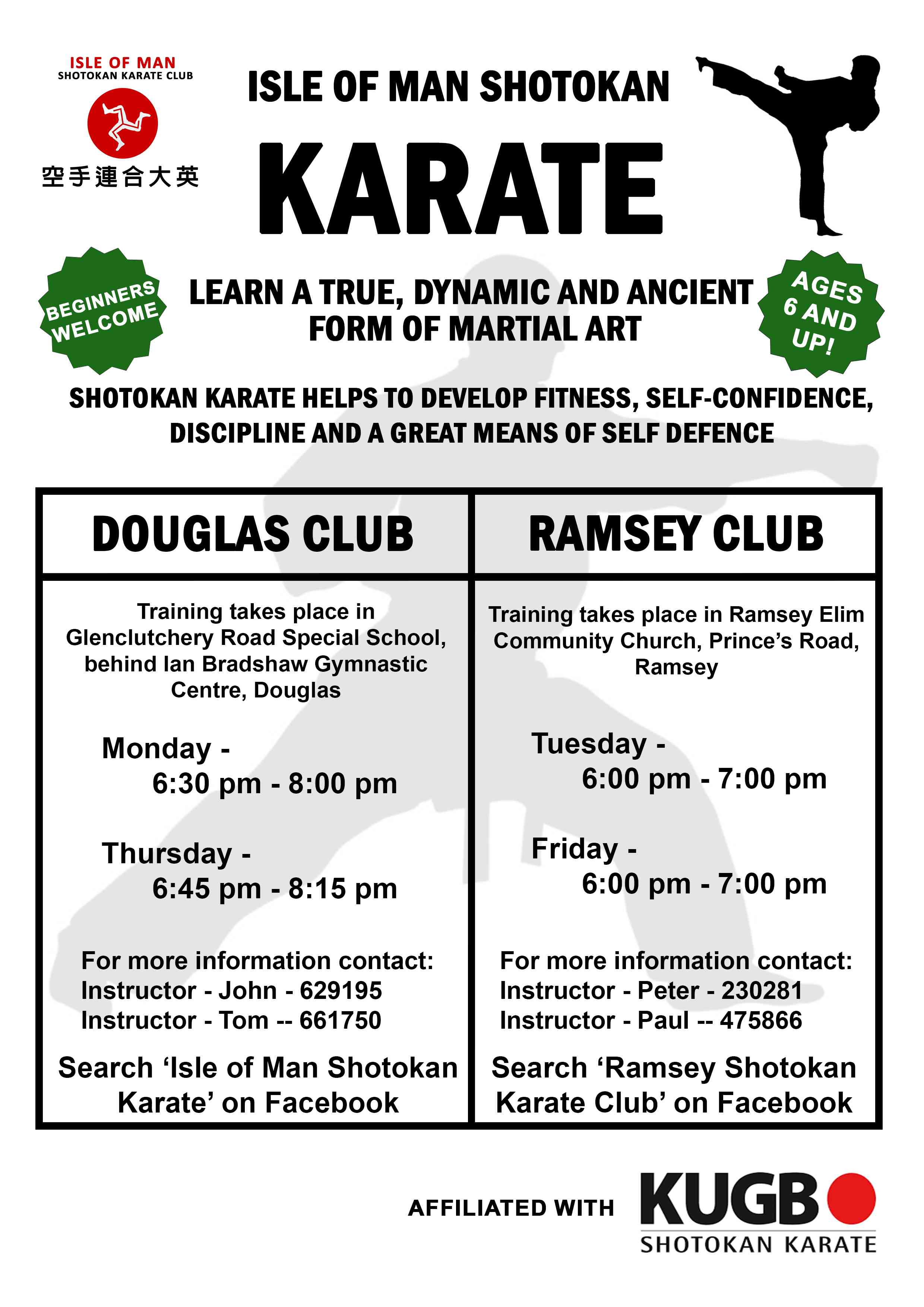
IOM Shotokan Karate ClubWhat is karate?Karate means empty-hand, it is a martial art that comes from the Ryukyu group of islands off the coast of Japan. The ordinary people of the islands who by law were not allowed to carry weapons formed it out of necessity. The islands were a trading route to China, Southeast Asia and mainland Japan. This allowed a large amount of social interchange and many martial art systems were taught to the islanders. Karate is a system of self defence and physical culture originally developed and refined in Okinawa and Japan. The word is formed from the Japanese words Kara (empty) and Te (hand), symbolising that its practitioners - Karateka - are unarmed, but use their hands and feet for blocking and striking. Training is conducted within an environment and code based on Japanese cultural practices, which are explained in more detail further on. You will quite often hear Japanese terms being used in your lessons. Click here to see what each term means along with finding some recommended books and videos to improve your krate knowledge. What is Shotokan?Shotokan is the name of the style of Karate founded by Gichin Funakoshi. There are various styles of Karate and Shotokan is the most widely practiced style in the world. The originator of Shotokan was Gichin Funakoshi, an Okinawan school teacher, who first demonstrated his style of Karate in Japan in 1921. The following year he moved to Japan to teach and was elected honorary Head of the Japan Karate Association (JKA) when it was formed in 1949. Shotokan karate produces powerful punches and kicks using the upper and lower parts of the body. The practitioners defend themselves with straight line strikes and attack with various parts of the body, including hands, arms, fingers, legs, elbows, knees, and feet. Those who practice shokotan always focus on breathing, speed, and balance. Its practitioners utilize long stances and long-range techniques during strikes What is the KUGB?The Karate Union of Great Britain (KUGB) is an association consisting of over 300 clubs all of which practice Shotokan Karate. It was established in 1965 as a democratic and non-profit organisation for the development of Shotokan karate and is affiliated to the official British, European and world karate governing bodies. It is by far the largest single style association in Great Britain. In 1965, the JKA sent four of its most famous and talented Instructors, Taiji Kase, Hirokazu Kanazawa, Keinosuke Enoeda and Hiroshi Shirai to tour Europe and give demonstrations of Shotokan Karate. The British part of the tour was coordinated by the British Karate Federation, a group of 10-15 clubs which had existed since 1959. In 1966, Sensei Kanazawa was invited to come to teach in Britain and the KUGB was founded from the BKA clubs as a democratic and non-profit making organisation for the development of Shotokan Karate, with Sensei Kanazawa as Chief Instructor. In 1968, Sensei Kanazawa resigned to teach in Germany and Sensei Enoeda was appointed as KUGB Chief instructor and remained in this position until his death in 2003. Sensei Enoeda was known throughout the world as the Shotokan Tiger and such was his renown, he appeared regularly in films becoming a friend and teacher to movie stars and members of royalty. He was a senior instructor in the JKA and the KUGB remained a member of this body until shortly after Sensei Enoeda's death. The KUGB is Britain's largest, longest-established and most successful single-style Karate Association. Can anyone practice karate?Anyone who is in reasonable health can train in karate. Any medical conditions should be reported to the Sensei at the start of training with the club, e.g. Asthma, Diabetes. The age groups range from 6 to 80 and members come from all sorts of different backgrounds. Our students range from the very young - 4 is the absolute youngest age because of insurance restrictions - right through to senior citizens. Karate students will improve their health, self-awareness, self-confidence and self-esteem. Parents and teachers continually report on the improvement in the behaviour of children who train regularly at KUGB clubs. This is because of our disciplined training structure and the emphasis placed on the Do, the behaviour aspect. Can I compete?The KUGB has had a National Squad since 1968 and compete widely throughout every continent of the world. The KUGB is fully represented at international level in Europe by English, Scottish and Welsh teams and at world level by the British team. The KUGB holds competitions for all ages and grades at both regional and national levels and these provide members with opportunity for selection to the national squad. |
|